Valorize in Press and relevant content
Margin and cost management strategy: profitability with focus, efficiency and control
Having a sound margin and cost management strategy is no longer an option: it is a necessity.
- All
- Blog
- Valoriza in the Press

15 de September de 2026
La valorización de intangibles determina el valor económico de recursos sin sustancia física que generan beneficios futuros para una empresa.

August 28, 2026
El test de deterioro de activos es la evaluación que determina si el valor contable de un activo excede el monto que la empresa podría recuperar.

August 20, 2026
Brand valuation is the discipline that translates this intangible asset into a substantiated, rigorous, and defensible monetary figure in front of third parties.

August 5, 2026
Are you looking to financially prepare your company? Do you need to attract investors? Check out this step-by-step guide.

August 5, 2026
Why a business succession fails and what successful ones have in common? Here we tell you.

July 30, 2026
Are you ready? We explain why confidentiality in company sales processes is relevant and the safeguards required.

June 23, 2026
This glossary brings together financial terms that appear in valuation processes, M&A, financing, and tax planning.

June 16, 2026
We help you understand what a debt restructuring is, when it is appropriate, and what the mechanisms are to execute it properly.

June 4, 2026
We explain what goodwill and PPA are, the regulations that govern them, and how to avoid the most common mistakes.

June 2, 2026
Corporate governance and corporate values are strategic pillars for companies seeking sustainable growth.

May 28, 2026
What are transfer prices, when is documentation required, valuation methods, and how to prepare to withstand a tax audit.

May 26, 2026
What is project finance, and how does it enable the financing of large investment projects while isolating the risk from the sponsors' equity?.

May 19, 2026
This guide explains how incentive systems work, when to use one type of incentive or another, and what you need to have figured out.

May 7, 2026
The Discounted Cash Flow (DCF) method is the standard benchmark for business valuation. This article explains how it is constructed.

May 5, 2026
This article analyzes sources of business financing, their characteristics, advantages, and limitations, with a view to strategic decision-making.

April 28, 2026
In business valuation, scenario analysis plays a critical role: it helps determine a range of values rather than a single number.

April 23, 2026
Credit ratings play a central role: they serve as the indicator the market uses to estimate the likelihood that a company will meet its obligations.

April 21, 2026
Hedging and financial derivatives are a necessary practice for companies seeking to protect their margins and provide certainty to their planning.

April 16, 2026
Companies that thrive have the tools and culture to anticipate the main types of financial risk.

April 14, 2026
Financial due diligence is the process of thoroughly verifying a company's economic and financial situation prior to a transaction.

April 9, 2026
Working capital management is a strategic factor that drives or destroys value. Here we tell you how to manage it.

April 7, 2026
Understanding the difference between Capex and Opex is fundamental to designing a value-creation-oriented strategy.

April 2, 2026
Understanding financial margins is essential for analyzing a company's health. In this article, we explain what to keep in mind.

March 31, 2026
In this article, we will analyze what financial leverage is, what its main benefits are, and the associated risks.

March 26, 2026
Understanding how WACC is calculated will help you turn it into a tool for making decisions about the future of your company.

March 24, 2026
NPV and IRR are part of technical analyses and constitute the heart of value creation. Understanding them is a strategic necessity for entrepreneurs.

March 20, 2026
In practice, understanding who is on the other side of the table is just as relevant as the economic value of the company.

March 18, 2026
The balance sheet is usually the first snapshot reviewed to understand a company's financial health. Here we explain how to take advantage of it.

March 12, 2026
Financial ratios are a key way to interpret accounting information and transform it into useful criteria for decision-making.

March 10, 2026
Both cash flow and profits are essential indicators, but they have different objectives. Here we explain why and how to work with them.

March 3, 2026
In this article, we look at Capex and reinvestments from a strategic rather than an accounting perspective. We analyze when the best time to invest is.

February 26, 2026
Errors that lower the selling price of a company? Yes, they exist, because selling a company is not just about finding a buyer willing to pay.

February 24, 2026
Here we explain step by step the signs that indicate your company is ready to be sold.

February 19, 2026
Review the factors that reduce a company's value, why the market punishes them, and how they typically become evident in valuation and M&A processes.

February 17, 2026
We define what EBITDA and profits actually measure, what they represent, why they are not equivalent, and how they should be correctly interpreted.

February 12, 2026
Discover the keys to successfully selling a company: valuation, identification of the ideal buyer, and effective negotiation.

February 10, 2026
In a business valuation, the goal is to answer the question: how much is this business worth today, considering what it can generate tomorrow?

February 4, 2026
There are different company valuation methods, each with assumptions and limitations. Here we explain which one fits your process.

February 3, 2026
M&A is a strategic tool. They work when they are aligned with a clear strategy, properly valued, and executed with rigor.

January 23, 2026
The market analysis brings together industry concentration, regulations, trends, and barriers as a comprehensive operational overview.

January 16, 2026
Business valuation can present accurate results of what a business is actually worth.

January 9, 2026
The importance of business valuation: reasons, benefits, and key scenarios for selling, making strategic decisions, and defining its value.

December 26, 2025
The discount rate represents one of the most determining factors in estimating economic value. Here we tell you why.

December 19, 2025
We explain how to manage access and financing costs in a dynamic and competitive business environment.

December 4, 2025
EBITDA is a financial indicator that measures a company's operating profitability.

October 23, 2025
Valuing companies in an inflationary economy is possible, and here we tell you how to achieve the best possible result for the business.

October 17, 2025
What price overvaluation is, how it differs from an economic bubble, and why company valuation is key.

October 8, 2025
Capex management is a concept that goes beyond an expense budget: it is the backbone of corporate reinvestment strategies.

September 30, 2025
In liquidation contexts, the valuation approach must be carefully selected to maximize return.

September 25, 2025
Working capital management is a priority for organizations seeking to maintain their liquidity and strengthen their financial position.

September 16, 2025
Having a sound margin and cost management strategy is no longer an option: it is a necessity.

August 23, 2025
How to grow sales without destroying value: clear value proposition, orderly commercial management, and customer experience as pillars.

August 11, 2025
How to measure the effects of company valuation: digitalization, AI, sustainability, and key factors for strategic decisions and M&A.

August 4, 2025
In this article, we explain each key stage to carry out a successful company acquisition.

June 25, 2025
Corporate governance, market analysis, and discount rate: three key factors that define a company's true risk and value.

June 18, 2025
Strategic financial management integrates working capital, Capex, and financing to sustain growth and strengthen the company.

June 3, 2025
Commercial and Operational Management becomes one of the most relevant strategic pillars within a value creation agenda.

April 4, 2025
Analysis shows that pre-money valuations in 2025 are rebounding to 2021 levels, with persistent gaps between the U.S., Europe, and LATAM.

February 14, 2025
What is business valuation, how is it calculated, and what models exist. Key factors such as ROIC, WACC, and growth to estimate a company's value.
February 5, 2025
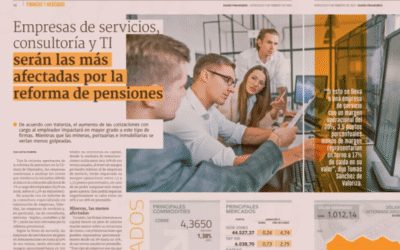
Diario Financiero quotes Valoriza: Pension reform impacts corporate valuations, with declines of up to 17% in the services sector and 3%–5% in capital-intensive sectors.

July 4, 2024
The discount rate (WACC) is key in the DCF: it reflects risks, defines a company's value, and underpins strategic and investment decisions.

April 26, 2023
A Valueza analysis shows a sharp decline in startup investment due to high interest rates and reduced liquidity, with declines of up to 57% in early-stage funding rounds.

March 24, 2023
There are several factors that can influence the value of a company, but the main ones are: [...]

June 24, 2021
Chile - and the world - is going through uncertain times. After the social outbreak of October 2019, the Covid-19 pandemic that has been present for several years [...]

June 4, 2021
Guide to the company sales process: key stages, timelines, risks, and why valuation and professional advisory maximize the price.
May 24, 2021
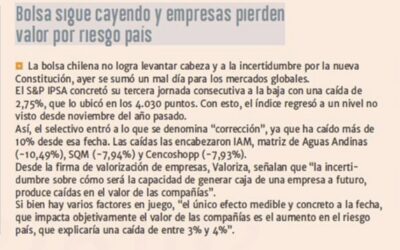
Diario Financiero analyzes how regulatory uncertainty and rising country risk are reducing the value of companies, with declines ranging from 3% to 4%.

May 5, 2021
Valoriza estimates that the third withdrawal boosted consumer spending but could lower the value of companies (2%–4.5%) due to higher risk and taxes.

April 28, 2021
Company valuation is based on its ability to generate future cash flow and on risk. Keys to negotiating and defining a fair value.

July 20, 2020
A study by Valoriza reveals that 30-day payment terms can increase a company's value by up to 42%, with an average increase of 17.4% depending on the sector.

July 20, 2020
The timely payment law improves the cash flow and value of SMEs. Max Errázuriz (Valoriza) explains its impact on costs, debt, and growth.

June 18, 2020
Max Errázuriz, CEO of Valoriza, talks on CNN about financial management, resource optimization, and how to maximize the value of a company.